
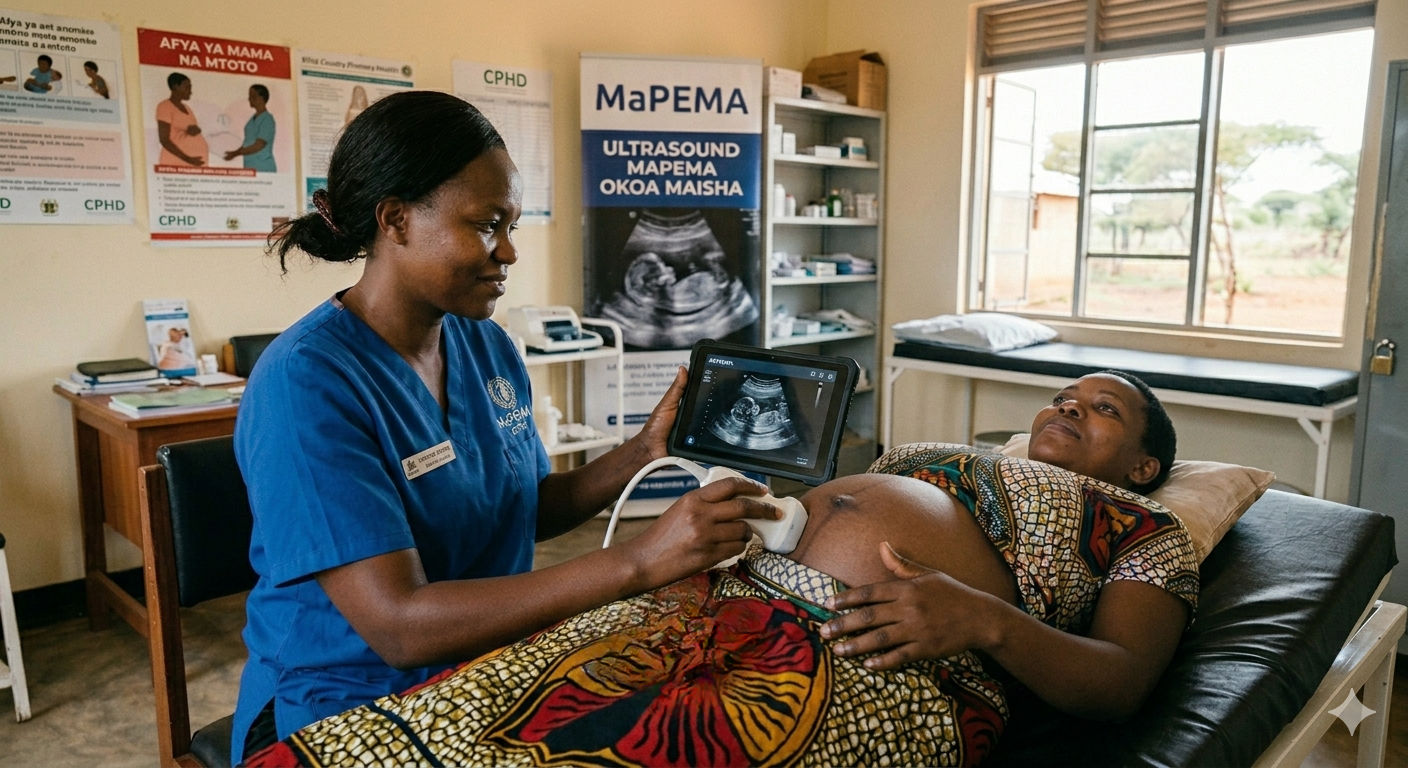
Most lower-level health facilities lack access to ultrasound services, leaving high-risk pregnancies undetected.
Making POCUS for Every Mother Accessible (MaPEMA)
Expanding access to life-saving ultrasound technology for safer pregnancies and deliveries
ABOUT THE PROGRAMME
Bringing diagnostics closer to those who need them most
MaPEMA (Swahili for “early”) is a national initiative led by CPHD to integrate Point-of-Care Ultrasound (POCUS) into maternal and newborn health services at the primary care level. By equipping frontline health workers with ultrasound devices and the skills to use them safely, MaPEMA improves early detection of high-risk pregnancies, strengthens referral systems, and brings diagnostic care closer to the communities that need it most.
The project combines technology, training, policy advocacy, and financing models to ensure POCUS is not only integrated into primary care but also adopted, sustained, and impactful.
THE CHALLANGE
The barriers standing
between mothers and
timely care
No Access to Imaging at Facility Level
Untrained Frontline Workforce
Healthcare workers are not routinely trained in basic obstetric imaging, creating a critical skills gap.
Weakened Referral Systems
Poor detection, delayed decisions, and inadequate documentation undermine the ability to refer mothers to higher-level care in time.
Financing & Procurement Gaps
Procurement and financing cycles often exclude affordable, portable technologies like POCUS, despite their potential impact.
OUR APPROACH
A systems-level response across three pillars
Training & Workforce Development
- Hybrid training curriculum developed with Ministry of Health, accrediting bodies, and professional associations
- Modular, simulation-based learning integrated into in-service training
- On-the-job mentoring and CPD accreditation pathways
- Facility-based team mentorship to embed ultrasound into routine care
Policy & Systems Strengthening
- Convened stakeholder discussions on POCUS service delivery, training, financing, and system integration
- Advocated for POCUS indicators in routine data and HMIS systems
- Supported formation of Technical Working Groups on POCUS use and AI in Medical Devices
- Developed national policies and supporting frameworks with MOH
Research & System Intelligence
- Engaged frontline workers to assess readiness and willingness to adopt POCUS
- Interviewed patients to understand trust in ultrasound-supported care
- Analyzed financing models for procurement, training, and service delivery
- Conducted a gap analysis on AI in medical devices potential and ethical considerations
KEY RESULTS
What Changed
Grounded evidence, validated tools, and approved national policy MaPEMA has moved POCUS from aspiration to infrastructure.
- Research provided evidence for strong frontline support for POCUS, high patient satisfaction with ultrasound-integrated care, and critical gaps in financing, workforce preparedness, and regulatory readiness.
- National POCUS training curriculum and training manuals for in-service training were developed, tested, and validated.
- New national guidelines, the National Framework for Integrating POCUS in Kenya's Healthcare System, developed and approved by the Ministry of Health.
- Formation of a growing POCUS community of practice across regions, connecting practitioners and driving peer learning.
- Regional commitment by LREB counties to promote and scale POCUS utilization at the facility level.
WHY IT MATTERS
MaPEMA isn't just about a device, it's about shifting how the health system sees, serves, and supports mothers.
By equipping frontline health workers with essential diagnostic tools, CPHD is reducing delays, improving clinical decision-making, and making maternal care more equitable across Kenya.
“When systems are designed to detect problems early, more mothers survive.”
“More babies thrive.”